One of the things I like most about visiting old houses, churches and abbeys is finding something I wasn’t really expecting to care about, and then thinking about it for days afterwards.
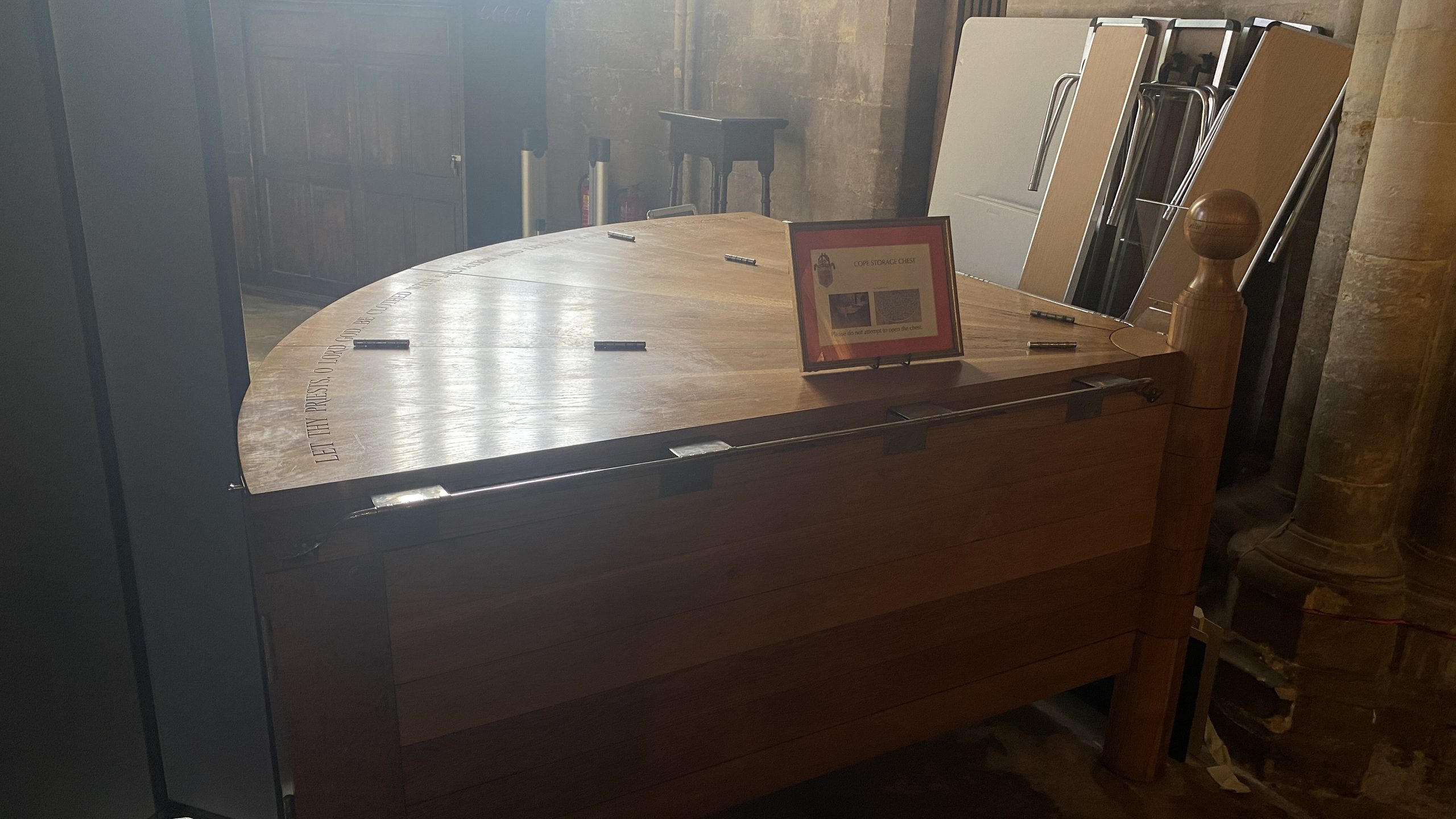
At Tewkesbury Abbey, that thing was the cope chest.
A cope is a large semicircular ceremonial garment, and because of the way they are made, they are not especially easy to store. Hanging them can put strain on the fabric, particularly if they are heavily embroidered, and folding them repeatedly is not exactly ideal either. So the obvious solution, if you happen to be a church with valuable vestments and quite a lot of space, is to make a very large, very specific piece of furniture for them.
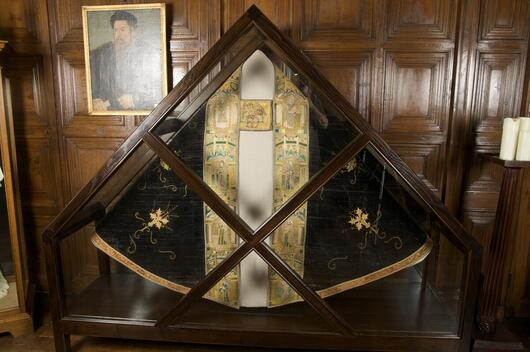
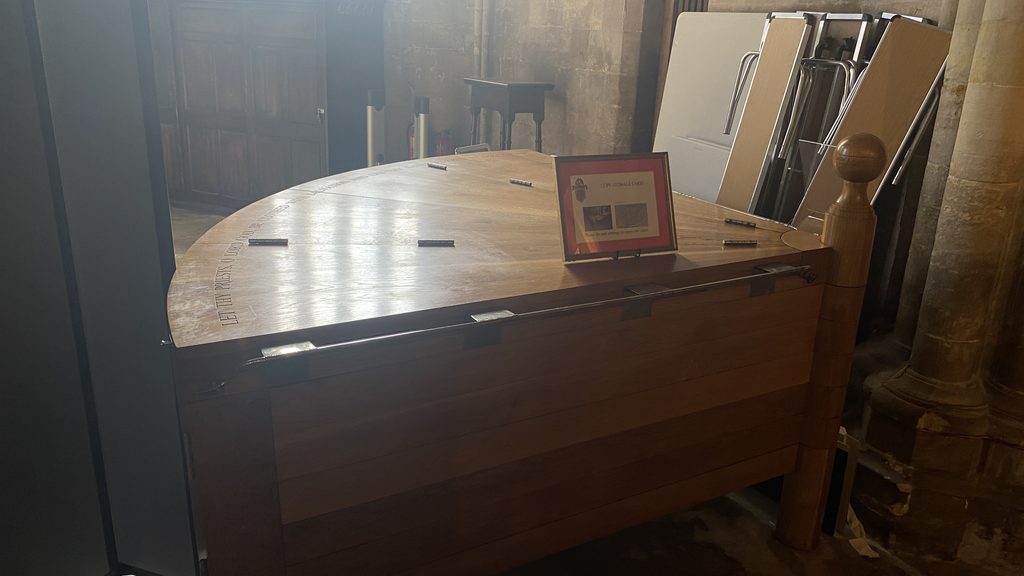
The cope chest at Tewkesbury is modern, but it is built around that old problem. It has these enormous quadrant-shaped drawers which pivot open so that the copes can lie flat. It is a ridiculous bit of furniture in the best possible way. It is huge, specialised, and exists because somebody decided that these particular textiles were important enough to deserve proper storage.
Naturally, I started thinking about Highguard.
Not because I think every Highborn chapter should own a giant semicircular chest, although I would be delighted if one did, but because the whole idea of it feels right for Highguard. If something matters, you do not just own it. You look after it properly.
We spend a lot of time at LARP thinking about the interesting objects. Banners, stoles, relics, chapter seals, ceremonial weapons, bits of scripture, shrines, documents, boxes of liao, and all the other things that acquire meaning because of what has happened around them. What we think about much less is where all of those things actually go when nobody is using them.
At an event, obviously, the answer is often a plastic crate. I am not giving up plastic crates. Plastic crates are excellent. They are waterproof, stackable, and much easier to get into a car than ecclesiastical furniture.
But in-world, somebody has to put the relics away.
Somebody has to decide where the old banners are kept. Somebody has to fold the stoles, catalogue the documents, repair the damaged embroidery, find somewhere sensible for the ceremonial silver, and know which chest contains the funeral vestments and which one has the things that only come out on particular feast days.
That is the bit that made the Tewkesbury chest stick in my head.
Highguard is very easy to imagine from the outside. We know what a chapterhouse looks like. Stone, arches, courtyards, cloisters, chapels, walls, towers, all that wonderfully solid Highborn architecture. It is much less common to think about what is actually inside the cupboards.
I can imagine Highborn furniture being quite plain in some ways. Not plain as in cheap, but not covered in decoration just because somebody had an empty bit of wood and a carving tool. Big tables, heavy benches, archive cupboards, racks for shields, chests built for specific sets of objects. Good materials, good construction, and the kind of thing that is expected to still be in use long after the person who ordered it is dead.
And some of it would be extremely specific.
That is the bit I really like.
I can absolutely imagine a Highborn chapter deciding that the Exarch’s vestments need their own chest, then making something absurdly well-built that is still being used three Exarchs later. Perhaps one section contains old stoles, another contains funeral cloths, another has banners that are no longer used but cannot possibly be thrown away because someone important died carrying one of them.
The furniture itself would start acquiring stories as well.
Perhaps the chest was made when the chapterhouse was founded. Perhaps somebody paid for it after the old one was destroyed. Perhaps it was built from timber salvaged from an earlier hall, or made by someone whose name is still recorded in the chapter archives. Give it another hundred years and the chest itself is probably an heirloom.
I think this is one of the things I like about Highguard generally. The culture is full of things that are supposed to endure. Buildings, institutions, records, oaths, names, relics. It makes sense to me that ordinary practical objects would end up carrying some of that weight as well.
The Tewkesbury chest also made me think about sacred objects being practical.
Its shape is strange because the thing inside it is strange. The drawers are curved because copes are curved. It is not trying to look impressive for the sake of looking impressive. Someone had a problem and built exactly the right thing to solve it.
That feels much more useful to me as a way of thinking about Highguard than just asking whether something looks vaguely medieval.
Since seeing it, I have found myself asking a slightly different question when I am thinking about Highguard props and kit. Not “is this medieval enough?”, but “what would a Highborn person actually make to solve this problem?”
That gets you to much more interesting places.
How do you store chapter records? Probably not in one random box full of loose paper.
Where do you keep relics? Does each one have its own little compartment, or are they wrapped and labelled?
What happens to a banner when it is too damaged to use but too important to throw away?
Where does the Exarch keep ceremonial vestments?
Who is responsible for all of this?
These are tiny questions, but they are exactly the sort of thing that makes a setting start to feel lived in.
It has also made me think differently about camp furniture at Empire. There are obvious practical limits, because everything still has to survive mud, weather, loading, unloading, and being rammed into a car on a Sunday afternoon. But I do like the idea that more of the storage can become part of the set instead of being hidden behind it.
A chest for vestments is useful anyway. So is an archive box for documents, a proper rack for banners, or a small divided chest for relics and ceremonial objects. None of them need to be enormous, and they certainly do not need to be exact historical reproductions. They just need to look as though somebody thought about what they were for.
And I think the answer would be different in every nation.
A Navarr solution probably has to travel. A Marcher one might grow out of ordinary domestic or agricultural furniture. A League one might become an excuse for showing off. Highguard, to me, feels like the place where somebody builds exactly the right thing, slightly over-engineers it, and expects it to still be doing the same job a century later.
That is really what I took away from the cope chest at Tewkesbury.
Not that Highguard needs more church furniture, although I am not ruling that out.
More that looking after an object is part of deciding that it matters.
If a chapter owns a banner, a relic, a stole, or a book that has survived several generations, then somewhere in that chapterhouse there should probably also be a very specific box, chest, cupboard, rack, or drawer that exists entirely because somebody cared enough to make one.
Leave a Reply