Blog

  • On Cope Chests, Highguard, and Looking After Important Things

    On Cope Chests, Highguard, and Looking After Important Things

    One of the things I like most about visiting old houses, churches and abbeys is finding something I wasn’t really expecting to care about, and then thinking about it for days afterwards.

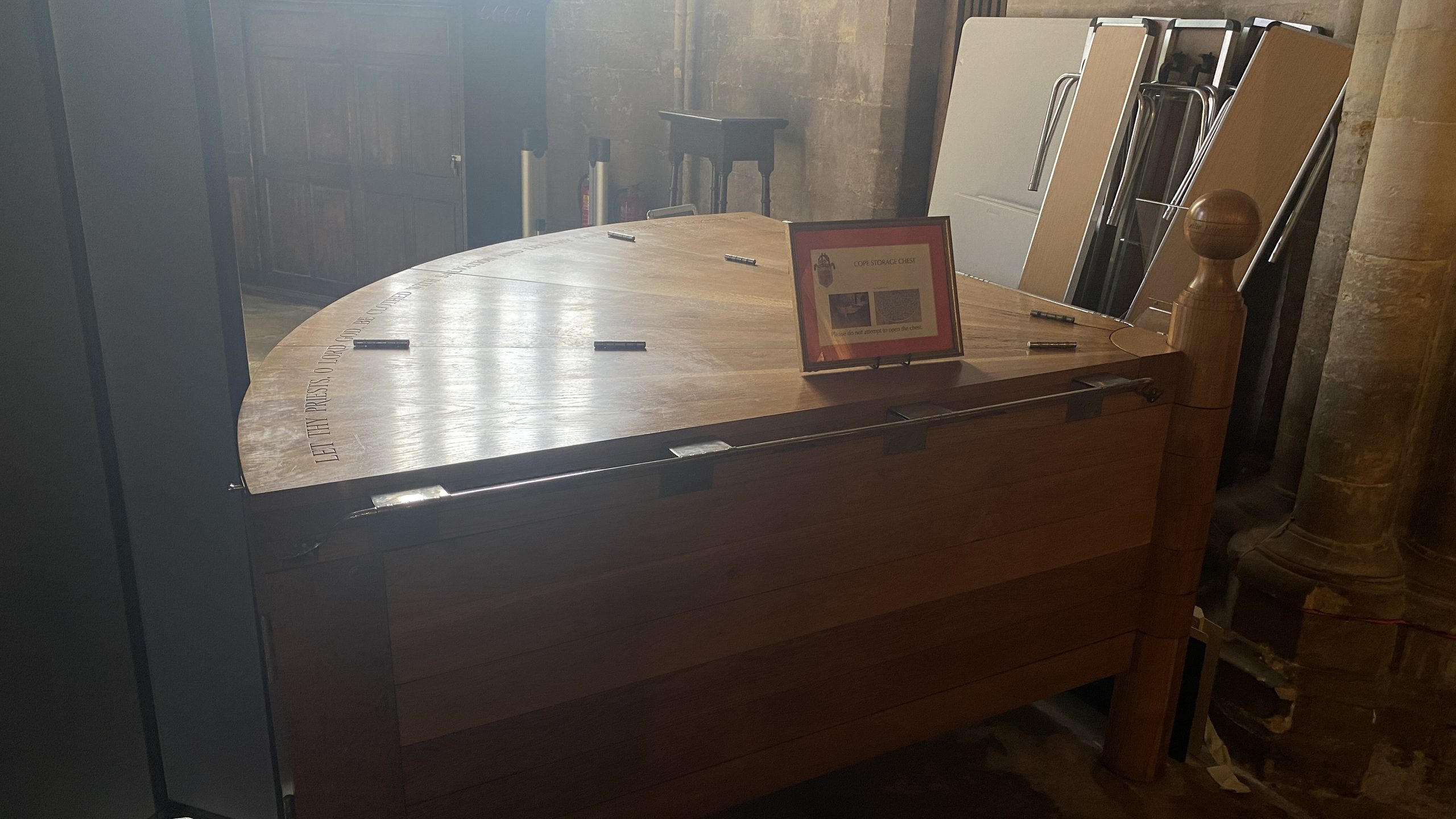
    At Tewkesbury Abbey, that thing was the cope chest.

    A cope is a large semicircular ceremonial garment, and because of the way they are made, they are not especially easy to store. Hanging them can put strain on the fabric, particularly if they are heavily embroidered, and folding them repeatedly is not exactly ideal either. So the obvious solution, if you happen to be a church with valuable vestments and quite a lot of space, is to make a very large, very specific piece of furniture for them.
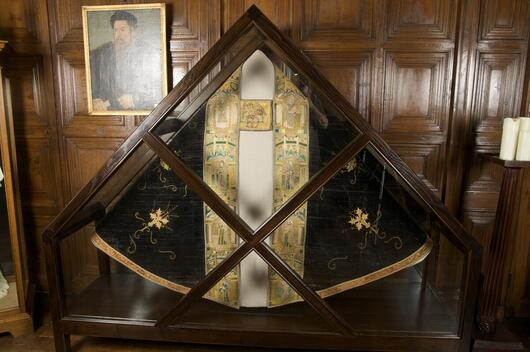
    An image of a Cope.
    The Catherine of Aragon Cope at Coughton Court. I didn’t take this picture, it is from the National Trust website.

    The cope chest at Tewkesbury is modern, but it is built around that old problem. It has these enormous quadrant-shaped drawers which pivot open so that the copes can lie flat. It is a ridiculous bit of furniture in the best possible way. It is huge, specialised, and exists because somebody decided that these particular textiles were important enough to deserve proper storage.
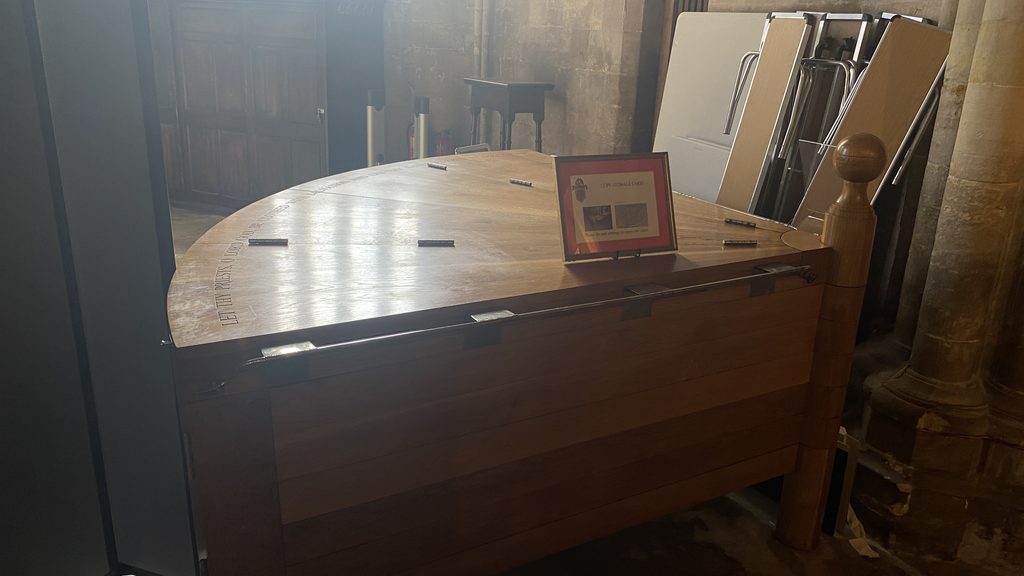
    The Tewkesbury Abbey cope chest that inspired this post.

    Naturally, I started thinking about Highguard.

    Not because I think every Highborn chapter should own a giant semicircular chest, although I would be delighted if one did, but because the whole idea of it feels right for Highguard. If something matters, you do not just own it. You look after it properly.

    We spend a lot of time at LARP thinking about the interesting objects. Banners, stoles, relics, chapter seals, ceremonial weapons, bits of scripture, shrines, documents, boxes of liao, and all the other things that acquire meaning because of what has happened around them. What we think about much less is where all of those things actually go when nobody is using them.

    At an event, obviously, the answer is often a plastic crate. I am not giving up plastic crates. Plastic crates are excellent. They are waterproof, stackable, and much easier to get into a car than ecclesiastical furniture.

    But in-world, somebody has to put the relics away.

    Somebody has to decide where the old banners are kept. Somebody has to fold the stoles, catalogue the documents, repair the damaged embroidery, find somewhere sensible for the ceremonial silver, and know which chest contains the funeral vestments and which one has the things that only come out on particular feast days.

    That is the bit that made the Tewkesbury chest stick in my head.

    Highguard is very easy to imagine from the outside. We know what a chapterhouse looks like. Stone, arches, courtyards, cloisters, chapels, walls, towers, all that wonderfully solid Highborn architecture. It is much less common to think about what is actually inside the cupboards.

    I can imagine Highborn furniture being quite plain in some ways. Not plain as in cheap, but not covered in decoration just because somebody had an empty bit of wood and a carving tool. Big tables, heavy benches, archive cupboards, racks for shields, chests built for specific sets of objects. Good materials, good construction, and the kind of thing that is expected to still be in use long after the person who ordered it is dead.

    And some of it would be extremely specific.

    That is the bit I really like.

    I can absolutely imagine a Highborn chapter deciding that the Exarch’s vestments need their own chest, then making something absurdly well-built that is still being used three Exarchs later. Perhaps one section contains old stoles, another contains funeral cloths, another has banners that are no longer used but cannot possibly be thrown away because someone important died carrying one of them.

    The furniture itself would start acquiring stories as well.

    Perhaps the chest was made when the chapterhouse was founded. Perhaps somebody paid for it after the old one was destroyed. Perhaps it was built from timber salvaged from an earlier hall, or made by someone whose name is still recorded in the chapter archives. Give it another hundred years and the chest itself is probably an heirloom.

    I think this is one of the things I like about Highguard generally. The culture is full of things that are supposed to endure. Buildings, institutions, records, oaths, names, relics. It makes sense to me that ordinary practical objects would end up carrying some of that weight as well.

    The Tewkesbury chest also made me think about sacred objects being practical.

    Its shape is strange because the thing inside it is strange. The drawers are curved because copes are curved. It is not trying to look impressive for the sake of looking impressive. Someone had a problem and built exactly the right thing to solve it.

    That feels much more useful to me as a way of thinking about Highguard than just asking whether something looks vaguely medieval.

    Since seeing it, I have found myself asking a slightly different question when I am thinking about Highguard props and kit. Not “is this medieval enough?”, but “what would a Highborn person actually make to solve this problem?”

    That gets you to much more interesting places.

    How do you store chapter records? Probably not in one random box full of loose paper.

    Where do you keep relics? Does each one have its own little compartment, or are they wrapped and labelled?

    What happens to a banner when it is too damaged to use but too important to throw away?

    Where does the Exarch keep ceremonial vestments?

    Who is responsible for all of this?

    These are tiny questions, but they are exactly the sort of thing that makes a setting start to feel lived in.

    It has also made me think differently about camp furniture at Empire. There are obvious practical limits, because everything still has to survive mud, weather, loading, unloading, and being rammed into a car on a Sunday afternoon. But I do like the idea that more of the storage can become part of the set instead of being hidden behind it.

    A chest for vestments is useful anyway. So is an archive box for documents, a proper rack for banners, or a small divided chest for relics and ceremonial objects. None of them need to be enormous, and they certainly do not need to be exact historical reproductions. They just need to look as though somebody thought about what they were for.

    And I think the answer would be different in every nation.

    A Navarr solution probably has to travel. A Marcher one might grow out of ordinary domestic or agricultural furniture. A League one might become an excuse for showing off. Highguard, to me, feels like the place where somebody builds exactly the right thing, slightly over-engineers it, and expects it to still be doing the same job a century later.

    That is really what I took away from the cope chest at Tewkesbury.

    Not that Highguard needs more church furniture, although I am not ruling that out.

    More that looking after an object is part of deciding that it matters.

    If a chapter owns a banner, a relic, a stole, or a book that has survived several generations, then somewhere in that chapterhouse there should probably also be a very specific box, chest, cupboard, rack, or drawer that exists entirely because somebody cared enough to make one.
  • Charlotte Sometimes is back

    Charlotte Sometimes is back

    About a year ago, Charlotte Sometimes disappeared from the internet.

    There was, in fact, a fairly dramatic reason for that: the site had become infected with a virus.

    By that point, though, the blog had also become a bit bitty. It had been around for years, my interests had wandered in all sorts of directions, and there wasn’t really much holding it all together. Faced with the prospect of cleaning up a compromised website that I wasn’t entirely happy with anyway, I took the whole thing down.

    I kept thinking about bringing it back.

    So, here we are.

    Charlotte Sometimes is back, although probably not quite as it was before.

    What is Charlotte Sometimes about now?

    The short answer is: things I find interesting.

    The slightly more useful answer is costume, history, sewing, craft, material culture, LARP, reenactment, gardens, and the various rabbit holes that connect all of those things together.

    I have never been particularly good at having hobbies that remain simple hobbies.

    It is rarely enough for me to decide that I would like to make a piece of clothing. I want to know how the original garment was constructed, what it might have been made from, who would have worn it, what evidence survives, whether the modern pattern everyone uses is actually based on anything, and why somebody in a manuscript appears to have done something completely different.

    Then, eventually, I might actually sew it.

    This is the sort of thing Charlotte Sometimes is going to be about.

    History, but with things in it

    I am particularly interested in the ordinary, physical bits of history.

    Clothes. Baskets. Textiles. Tools. Gardens. Household objects. The things people made, repaired, carried around, wore until they wore out, and probably didn’t consider remotely interesting at the time.

    Material culture is one of the places where history becomes wonderfully specific.

    It is one thing to know broadly how somebody in the thirteenth century lived. It is another to find yourself wondering what shape of basket she would have carried to market, how it was constructed, and whether the nice one you’ve found for sale actually looks anything like the baskets in contemporary images.

    I enjoy that sort of problem far more than is probably reasonable.

    There will be research here, but I don’t want Charlotte Sometimes to become somewhere that simply repeats historical facts. I’m interested in what happens when you actually make things, wear them, grow them, repair them, and use them.

    Sometimes historical techniques make immediate sense once you try them. Sometimes they absolutely do not. Both are interesting.

    Costume, sewing, and making things for imaginary people

    There will be a lot of sewing.

    Some of it will be historical costume, and some historically inspired. Some will be experimental. Some will be meticulously researched. Some will begin with historical evidence and wander cheerfully off into fantasy.

    I make costume for LARP, particularly Empire, and I am fascinated by the point where historical clothing and fantasy costume meet.

    I think there is something much more interesting about starting with the shape, construction, materials, and visual language of real clothing, and then deciding where to depart from it. Fantasy does not have to mean attaching another belt to something.

    Although I reserve the right to attach unnecessary belts where appropriate.

    I’ll be writing about garments I’m making, fabrics and materials, embroidery, construction techniques, repairs, costume design, and the research behind various projects.

    There will almost certainly be quite a lot about medieval clothing.

    I make no apology for this.

    LARP and reenactment

    LARP will have a home here too.

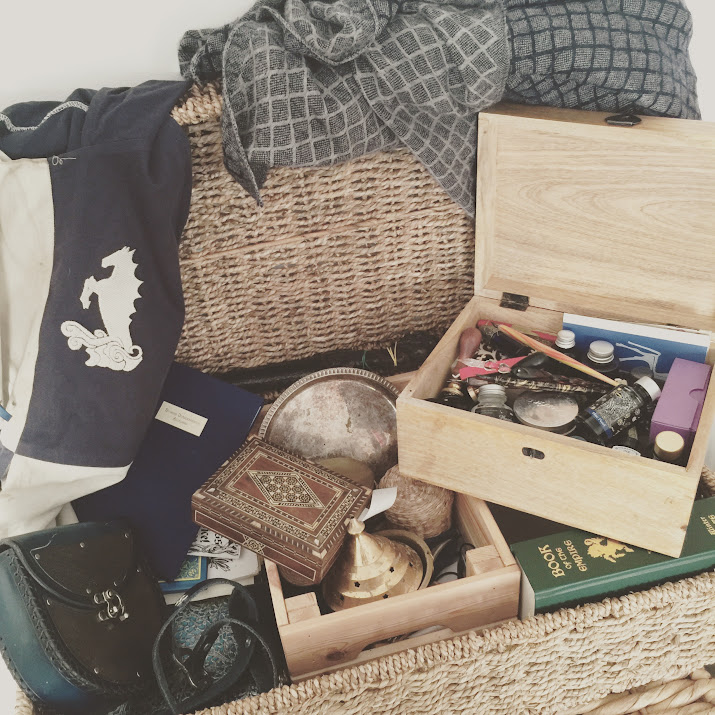
    Not really the game mechanics side of it, but the material side: costume, props, camp equipment, banners, practical kit, visual worldbuilding, and all the tiny details that make an imaginary world feel as though somebody might actually live in it.

    I’m also becoming increasingly interested in reenactment and living history, particularly the bits concerned with everyday life rather than combat.

    That overlaps rather neatly with another longstanding fascination of mine: experimental archaeology.

    There is a particular kind of knowledge that only appears when somebody actually tries the thing.

    How awkward is that garment to work in? How much can that basket carry? How quickly does something wear out? Does this method of construction make more sense once you’ve used the finished object?

    These aren’t always questions that can be answered by looking at something behind glass.

    I suspect there will be quite a lot of trying things.

    And then there’s the garden

    The garden might initially seem like the odd one out.

    It isn’t, really.

    I grow things because I like gardening, obviously, but I am also increasingly interested in useful plants and in producing a little more for myself.

    Plants for dyeing. Plants for herbs. Plants that have a history. Things that can be eaten, dried, preserved, woven, brewed, cut, coppiced, or turned into something else.

    This is how you end up growing madder for several years because eventually you might want some red dye.

    Apparently I consider this perfectly normal behaviour.

    There will also be a bit of self-sufficiency and practical preparedness here. Nothing terribly apocalyptic, but I am interested in growing food, preserving it, keeping useful things to hand, reducing waste, learning practical skills, and generally making the household a little more resilient.

    I like knowing that I can make, mend, grow, preserve, or improvise something when I need to.

    So there will be ordinary gardening here, but also natural dyes, useful plants, historical gardens, edible growing, preserving, growing materials for craft, and assorted experiments in seeing how much I can produce from a relatively small patch of ground.

    Some of them may even work.

    Mostly, though, this is a blog again

    I don’t want Charlotte Sometimes to become a perfectly curated collection of definitive guides written solely because somebody might type the right combination of words into Google.

    I miss blogs.

    I miss people having slightly peculiar corners of the internet where they documented things they were interested in. I miss following projects as they developed, reading about experiments that didn’t quite work, and finding a post about something so absurdly specific that you couldn’t believe somebody else had wondered about it too.

    I’d like Charlotte Sometimes to be one of those places.

    There will be properly researched articles and useful guides, but there will also be projects, experiments, works in progress, things I’ve discovered, things I’ve changed my mind about, and probably occasional dispatches from particularly deep research rabbit holes.

    I’m not promising a rigid publishing schedule, and I’m not going to pretend all of these subjects fit neatly into separate boxes. They absolutely don’t.

    Costume leads to textile history. Textile history leads to natural dyes. Natural dyes lead to the garden. The garden leads to food preservation and self-sufficiency. LARP leads to historical clothing. Historical clothing leads to material culture. Material culture leads to an inexplicably detailed investigation into medieval baskets.

    And suddenly it’s three hours later.

    Welcome back to Charlotte Sometimes.